

Here at Enki we love data and quantifying things, so naturally we have to calculate exactly how miserable we are. And the last couple of weeks have provided a LOT of data in that area. It’s especially problematic because the new resident, Siegfried, isn’t able to be outside enough to burn off all the energy his 18 month old Dachshund physique can store up, so he wants to play when it’s cool. Say, 3am. Which isn’t conducive to a good night’s rest.
Naturally, three questions come to mind. How miserable is it, is our misery unusual, and please God when will it end?
Numbers first: The official way we measure summertime misery is the heat index. Here’s the NOAA page describing how the heat index works. It’s basically a way of simply saying how much hotter it feels because of humidity. The humidity matters a lot because your body gets rid of excess heat by sweating, and the evaporation of that sweat is what causes the cooling. The problem is that the evaporation rate depends on the humidity – the higher the humidity, the slower the evaporation rate until it just stops working. The heat index calculation is an attempt to capture that effect.
This week the heat index has literally been off the charts. Once it gets about 120 or so it doesn’t really matter because your sweat has stopped working. And we’ve hit that and higher every day this week …
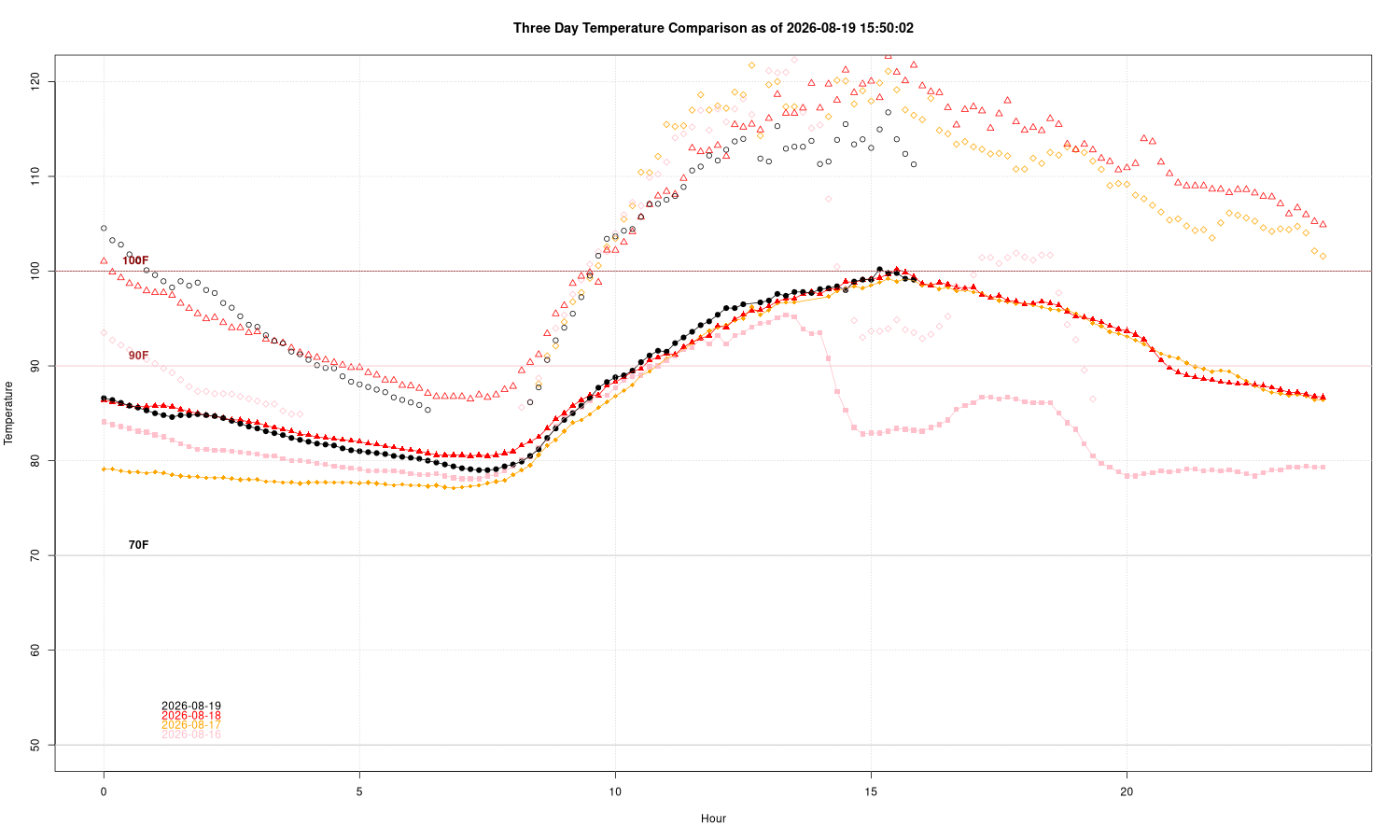
Today (Wednesday the 19th) the air temperature in mid-town Savannah hit 100.2, that corresponds to a heat index of 124. Also, higher humidity at lower temperatures, even 80s, may be dangerous/uncomfortable because what we really want is the evaporation rate, but not too many people can relate to erg-grams per square centimeter per second 😛 …
So is this unusual? Yes. While we aren’t hitting record temperatures, our nighttime lows have set records on a few days, and that makes things worse on a lot of levels due to thermal inertia of buildings and overworked air conditioners. But the biggest problem is the humidity is running about 10% above average, and during the day has been 20% above normal at times. So if the air temperature is 95 F, a humidity of 45% gets you a heat index of 102. Bad enough but this is the south so get over it. But what happens if the humidity is 65%, as it has it a few times this week during mid-day? The heat index soars to 118 F. We’ve have temps of 95 and 75% humidity late in the afternoons, for heat index values in town of 128 F!
Another caution, from the NWS site, is this: Since heat index values were devised for shady, light wind conditions, exposure to full sunshine can increase heat index values by up to 15°F.
When will it end? The snarky answer is of course “Fall,” but the more immediate answer is that it looks like we will have higher periods of temps and humidity for another couple of weeks. We might get some relief this weekend, but the long range seasonal forecasts show above normal temperatures through the end of the year, but once air temps get below the 90s, and especially when it drops in to the lower 70s upper 60s at night, we’ll all be happier.
By the way, the phrase “dog days” comes from Roman times when they noticed the hottest part of the year also coincided with the alignment of the brightest star in the sky Sirius, with the sun. Sirius is called the Dog Star because it is also the brightest star in the constellation Canis Major (the greater dog – yes, there is also a Canis Minor). So they figured that had something to do with it. And the name “Sirius?” It’s from the Greek, Σείριος, or “scorching” …

It’s a good thing Sirius doesn’t really have anything to do with the temperature (the energy it adds is trivial), because it is moving closer to us and in 60,000 years or so will reach it’s closest approach and be about 1/3 brighter than it is now. Meanwhile, “enjoy” the dog days …

If you appreciate the blog, the best way to get it is to subscribe to the emails. You can subscribe and also donate to keep it going at this link. Many thanks to those who have contributed to keep the blog going!
You can also follow us on Musk’s Madhouse X/Twitter (@EnkiResearch), Telegram, BlueSky, or even Fakebook if that is your preferred social media quagmire. But be aware that social media algorithms don’t like to show you posts in chronological order. They “upgrade” sensationalist material, and “downgrade” posts that have outside links in order to keep you on their platform, so it’s not a great way to get weather warnings or news (or anything other than a variety of gastrointestinal symptoms for that matter).
The pupper is adorbs!
Cute picture of your dog. Does he care what happens to pictures of him? Looks a little concerned.
Thanks for the update, depressing as it is.
Maybe bright Sirius, the alpha dog of Canis Major, is obscuring Planet X, and gravitational lensing is focusing the star’s hot light on Greater Frogmore