

Every now and then I’ll get a question like “why should I care if there is a hurricane in the Southern Hemisphere near an Island I’ve never heard of.” The main natural hazard I’m watching at the moment is Cyclone Belal, which is passing the French Department of Reunion today. In this case, the impact of this storm is exaggerated because the fire apes can’t get along and are shooting at one another, and aside from the human impact, it is disrupting the alternate shipping route through the Red Sea. Take a look at this map, from marinetraffic.com (link):
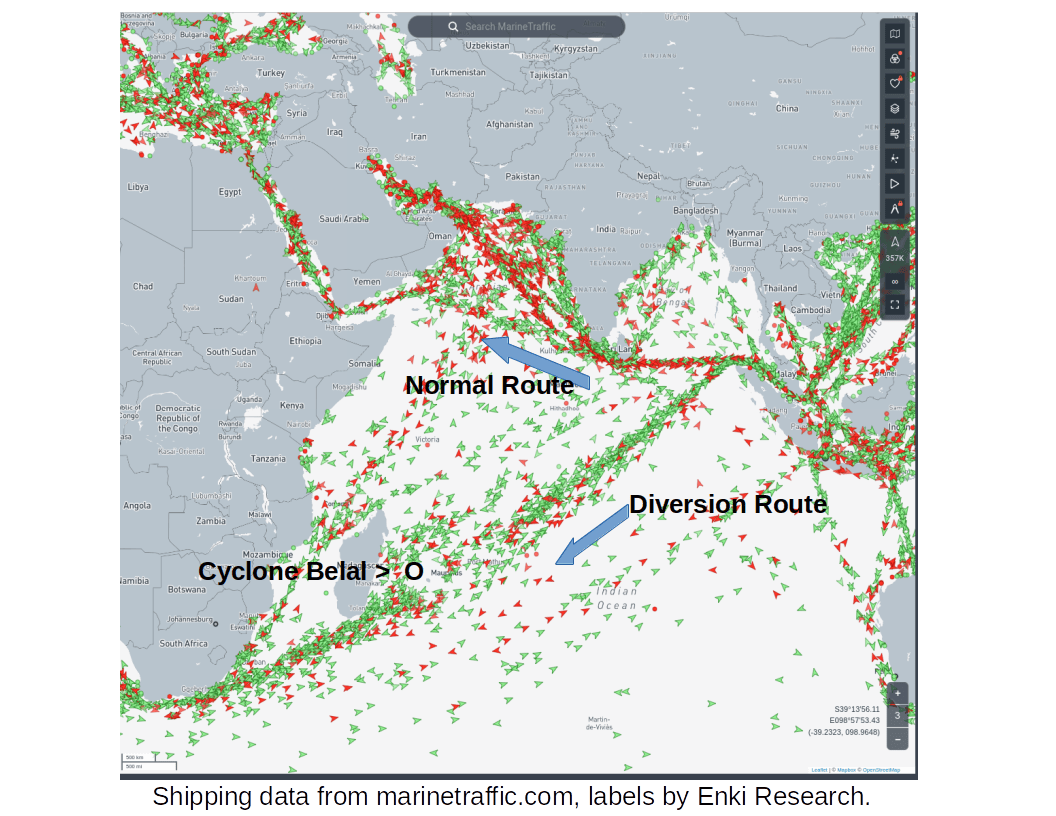
Because of the conflict with Ansar Allah in the Red Sea, ships are having to divert around the horn of Africa. See that “hole” in the diversion route? That is a further delay caused by ships slowing down or going around the storm. Now, most of the Red Sea traffic is going to Europe, but it has a cascading effect. Shipping is a finely tuned choreography of goods, containers, and transport capacity. A delay in one area cascades across the system. Although it most directly effects shipping to Europe from Asia, the net effect of the loss of the Red Sea corridor has reduced global shipping capacity by somewhere between 10 and 15% (link to CNBC article). So stuff that was supposed to be shipped from Asia to reach the US in time for spring is also impacted. Belal is aggravating that situation, adding time and costs to the global system.
The global economy has some advantages, but has some significant disadvantages, among them increasing the fragility of the global economy by reducing the resiliency and vulnerability of society to human and natural disasters. This is why I am skeptical about the further expansion of the Port of Savannah, because while it might provide some local economic benefits, the net impact of globalization on the economy and living standards of both Georgia and the US has become negative. It’s a complex discussion involving secondary and tertiary impacts that are often overlooked. But events like the war in the Middle East, COVID, and smaller disruptions like Belal should be warning signs that maybe we should reconsider the system, and encourage more local production, especially of vital goods. That’s a lot harder (and more expensive) when you facilitate the shipping industry with larger port capacity.

As for direct impacts of the storm, fortunately, Belal has not strengthened as much as was forecast yesterday, although the track is still directly over Reunion. This is still going to be pretty bad – and will be devastating to the Island (France 24 article).
Thank you for your comment about the Port Of Savannah expansion. I get crazy looks when I say I’m think it’s continuing growth is not a good idea.
Your intelligent comments about world issues/political matters, all beyond weather issues is appreciated. You are a fine meteorologist, but you ‘ain’t just that.
ayoung
Thanks! For the record, I’m not a meteorologist, I’m a Cassandra, um, geophysicist and geopolitical analyst.
Thank you for all the information. The marine navigation map was fascinating and made the world seem really,, really small.
And, again, Mr. Chuck … you make excellent points that few is us would even ponder … thank you!