

Update: Got a note from the NASA PPS (Global Precipitation Program) manager this morning (1 July): It was announced on Monday, June 30, that NASA requested and it was agreed to postpone the removal of SSMIS data and to continue processing and distributing DMSP data through July 31st.
There is a lot of angst in the tropical weather community over the shutdown today (30 June) of the Defense Meteorological Satellite Program (DMSP) satellites and the potential impact on hurricane forecasting. As usual in America, political fingers are being pointed. And, as with most situations, there is plenty of blame to go around. While the Trump Administration stuck the final knife in the program, it had been dying the death of a 1000 cuts for at least twenty years, and this episode is a classic example of many of the things that are wrong about the American approach to government, defense, and science. This will be another classically long blog post, looking first at what is happening, then the potential impact of the loss of these sensors, and finally at the broader problem of the dysfunctional nature of American government with respect to “Big Science” and Defense.
The DMSP program is a joint program between NOAA and the Defense Department. Originally classified, DMSP has been a huge success and for the last 40 years much of the data has been shared and openly used by NOAA and other meteorologists. Currently it consists of several aging satellites, the youngest launched in 2009. DMSP had been scheduled for termination at the end of FY26 (September of 2026). It was supposed to have been replaced by the Defense Weather Satellite System (DWSS), which was canceled in 2012. The DWSS, together with the still continuing Joint Polar Satellite System (JPSS) project, was to replace the National Polar-orbiting Operational Environmental Satellite System (NPOESS) project, which itself was cancelled in January 2010. Combined with the ongoing turmoil in related NASA Earth System Observation programs, things are a big mess.

Finally, DMSP was replaced by the Weather System Follow-on Microwave (WSF-M) program. The first WSF-M satellite was launched last year and is now operational. A key problem is that the WSF-M data is not available outside DOD. The abrupt termination of the DMSP microwave data, and the unavailability of the WSF-M data has raised speculation that this is security related, and in fact DOD has been nervous about civilian microwave sensors for some time, and I suspect this is a contributing reason behind the termination.
Why? Because using interference patterns from this class of sensor, if you know what you are doing you can assess the location of military radar sites, such as those used in Patriot, Aegis, and THAAD anti-missile systems, such as this Patriot missile battery at Al-Udeid Base in Qatar.

Is that a valid concern? For a lot of technical reasons I won’t go in to here in part because they touch on sensitive topics, I think this is an unwarranted level of paranoia, as well as an excuse to limit data so that commercial providers can control the data (and profit stream). In any event, the data streams will be shut down as of the end of this month (30 June).
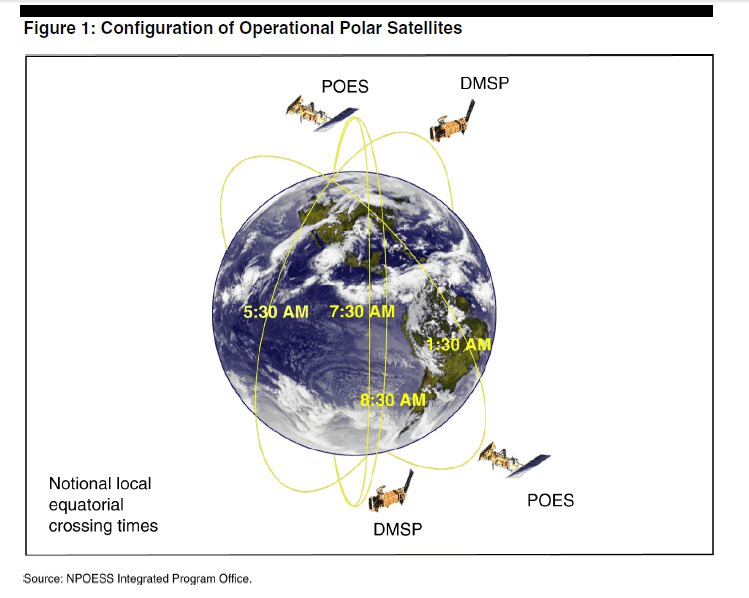
What are the impacts of this early shutdown? The main concern expressed in the news is with respect to hurricanes, and many of you have read reports such as this one (link). The abrupt notice caught everyone off guard, but this loss is damaging across the board, not just to tropical forecasts. For example, one of the main rain monitoring tools we have is the NASA Global Precipitation Mission, which integrates data from a variety of satellites to produce best estimates of rainfall worldwide. This data is used for initializing computer models as well as for drought monitoring, flood prediction, and even as an insurance trigger in some parametric insurance policies. To quote from a message sent by the project manager the 28th, “The lack of these 3 conically scanning radiometers will impact the accuracy of all IMERG products as they will have data from 3 fewer radiometers (out of the current 11), whose high-quality data help to fill the 8 hour gap between the main agency radiometer orbit times (01:30 and 09:30 a.m./p.m.).“
The bottom line is this will degrade operational data assimilation and will undoubtedly impact forecasts of all types. It’s not catastrophic, and there are some work arounds, but it is unwelcome, and the extremely short notice has folks scrambling for alternatives. We were expecting to lose DMSP data next year – but to have it dropped with so little notice is incredibly disruptive. There has been some talk about costs, but the satellites are already on-orbit, the processing costs are trivial compared to the advantages of having this data. There may be some cost savings, but this isn’t trimming duplication or increasing efficiency, it is trimming an essential service. In short, this early termination makes no sense to me. It feels like politics, with some paranoia thrown in.
So how did we get here? As noted above, the polar orbiter programs have been in turmoil for at least 25 years. This is symptomatic of a much wider problem in America, be it with science, defense, or many other areas: the lack of continuity, and near inability to plan multi-year projects and policies. And those problems are in part derived from an underlying myth about government.
Since Republicans and Democrats increasingly lack any set of shared values, programs start and stop, or are redesigned in effect resetting the development clock, so that as noted above with the DMSP follow on, they are delayed to the point of crisis. As the composition of the House and 1/3 of the Senate changes every two years, and President potentially changes hands every four years, budgets have very little stability – even assuming there is a budget. It is becoming increasingly impossible to do long range planning in government programs. Even if you get the go ahead, the rug can be pulled out at any time, even as the project approaches deployment, such as DWSS/JPSS.
The push to privatize government weather forecasting and systems (as well as other services such as the logistics and repair elements in DOD) has been going on for decades. It is, in my view, ill conceived and harmful on many levels. As a result, an increasingly significant factor is that now there are multiple commercial providers competing for government contracts not just to build systems that are turned over to the government for operation, but to own, manage, and provide the raw data. This puts a lot of pressure on Congress to discontinue programs, change vendors frequently, and limit public access to that data.
As anyone with a cell phone knows, there is a constant drumbeat to upgrade. While there are some technological reasons to do that, the primary driver is that the big profits are in new sales, not in maintenance of existing, fully functional and capable systems. Of course that route is more expensive for the consumer (in this case, you, the taxpayer), not to mention disruptive, as I have rarely met an “upgrade” of hardware or software that did not involve some kind of glitch or disruptive change in procedures.
This constant instability is destructive to good science, which requires continuity as well as improvement. Up until the 1990’s, as satellites improved, there was almost always overlap between generations. That enabled us to understand how the old and new systems “saw” things differently, enabling direct comparisons. Today there is little overlap and even gaps between generations of satellites, meaning historical time series are are less accurate. This is especially destructive for climate research, where small variations are vital, yet those small variations can be swamped or called in to doubt by sensor changes over time.
A lot of the problems in the U.S. with respect to governance stems from a philosophy that underlies American society. One of the enduring myths in America is that Business can do things better than Government. I’ve had the chance to work in all of the major realms – Civil Government, Defense/Intelligence/Security, Academia, and the Business world. Each has very different objectives and metrics for success, and while one can take lessons from one realm and apply it to the others, they are not the same. Applying the wrong lessons is a frequent cause of misery.
I write occasional articles for a highly respected investment and market research newsletter (subscriptions are not cheap, but if you are in that world it is absolutely the best information out there). In one recent article I wrote about the experiences of successful businessmen in attempting to reform the Defense Department, and why those reforms often fail or result in less security. In business, efficiency is everything; in some government programs, it is not the priority and in some cases “efficiency” is actually counterproductive. The latest, greatest technology can sometimes create vulnerabilities that are either poorly understood or unknown – until it is too late. Finally, the most effective change takes time and you won’t get credit for it – the next administration, or even two or three administrations down the road will reap the benefits. Yet getting credit is vital for businessmen – and politicians.
Elon Musk’s approach, known as the “Musk Algorithm,” is a classic example of something that works in business – but fails when applied to “big science” and government. As Todd Harrison of AEI wrote last year, “The practitioners of the Musk Algorithm should understand that some inefficiencies in the military are by design: they are strategic choices that maintain options in unlikely but highly consequential scenarios.” DMSP, likely in part a victim of the Musk/DOGE budget cutters, probably falls in to that category. For day to day forecasts the extra microwave radiometer passes don’t matter much. In rare – but consequential – situations, they are an important tool. In the business world you tend not to worry much about the 10 year scenario, much less the 100 year event. You care about quarter over quarter profits, and protecting against the rare circumstance at some point starts to hurt efficiency and overall cost effectiveness.
But when lives or security are at stake, that’s the wrong calculation.
Obviously this is a complex subject, and even a longish blog post can’t do it justice. Yes, government and the academic world can do things “better” by taking lessons from business such as strict accounting, streamlining, avoiding unnecessary duplication, and so forth. Likewise, business can learn something from both government and academia, that efficiency and short term advantage isn’t everything if it is at the cost of long term stability, and human beings should actually matter and be factored in to the bottom line. Balance is the key, as is understanding the different roles each of these realms plays in a functional society.
In short, neither political party has been responsible when it comes to the U.S. polar orbiter program, much less the wider aspect of government operations. Blame Trump if you want to (and you should), but also blame Obama and the Democrats for disrupting the follow on evolution and planning. DMSP is just the latest program to fall to the ongoing decline in the quality of government services in the US, a victim of politics and misplaced priorities.
Of course, the real victim isn’t DMSP – it’s you.
Good stuff, lots of blame to go around. Or should I say “opportunities?” We spend lots of taxpayer dollars to send these folks to Congress to represent us and they do a lousy job of it. I wish I knew how to fix it, I could be rich just like them…
Thank you for the very informing post. Wish I knew how to reform the system but I don’t. Would you care to lead us?
Very informative fact-based post. Thank you!
Thank you for taking the time to write this.
Thank you!
This post resonated with me because I have a son (GaTech MEAS graduate) who recently lost his job due to the NOAA funding issues and volatility. The company he worked for was doing, in short, satellite data analysis and new software programming – one of their major clients was NOAA. It’s frustrating we have had such an outdated/broken system for decades in ‘good’ times. However, in this current political ‘climate,’ it seems we’re taking so many steps backwards that it’s becoming even harder to see the way out to update the technology (and legislature) that so desperately needs the prioritization. I’m sad not only for my son who wants a job in his field, but also for the people (especially in higher-risk weather areas) who rely on accurate forecasting to help save lives. We have been following your posts for years and truly appreciate your time and effort both locally and globally. Thanks for all you do!