

So NHC has churned out a new forecast, and the Enki computers are busily creating heat to aid Nicholas in his napping activities and, as a side effect, generating economic loss estimates. So how does that work?
I really can’t say much more than is in the paper that Mark Johnson and I wrote back in 2004 for the Bulletin of the American Meteorological Association, “Hurricane Loss Estimation Models: Opportunities for Improving the State of the Art“.
The storm hazard and economic models have improved over the last 20 years, but the way it works is essentially the same: run combinations of models with different assumptions and see if what comes out makes any sense. Normally they do, sometimes like with Milton the spread in estimates is a lot higher than we’d like. In this case here is the “big picture” showing the impact estimate distribution:

Note the main peak is between $20 and $30 Billion, but there is a cluster at $60 Billion, and a significant number of runs came in at less than $10 Billion. These three scenarios are the “hit Florida as Cat 3+” (high), “hit Florida while decaying and accelerating” (the middle $20-$30 Billion estimates), and the “fall apart before landfall” scenarios (low end).
The reason for the three scenarios is the fact, noted this morning, that the storm is being pushed along by a front that might make the storm stronger or just as easily tear it apart with shear and dry air. Here is a plot of surface pressure and wind shear for Wednesday morning at 2am ET, from the GFS Forecast model:

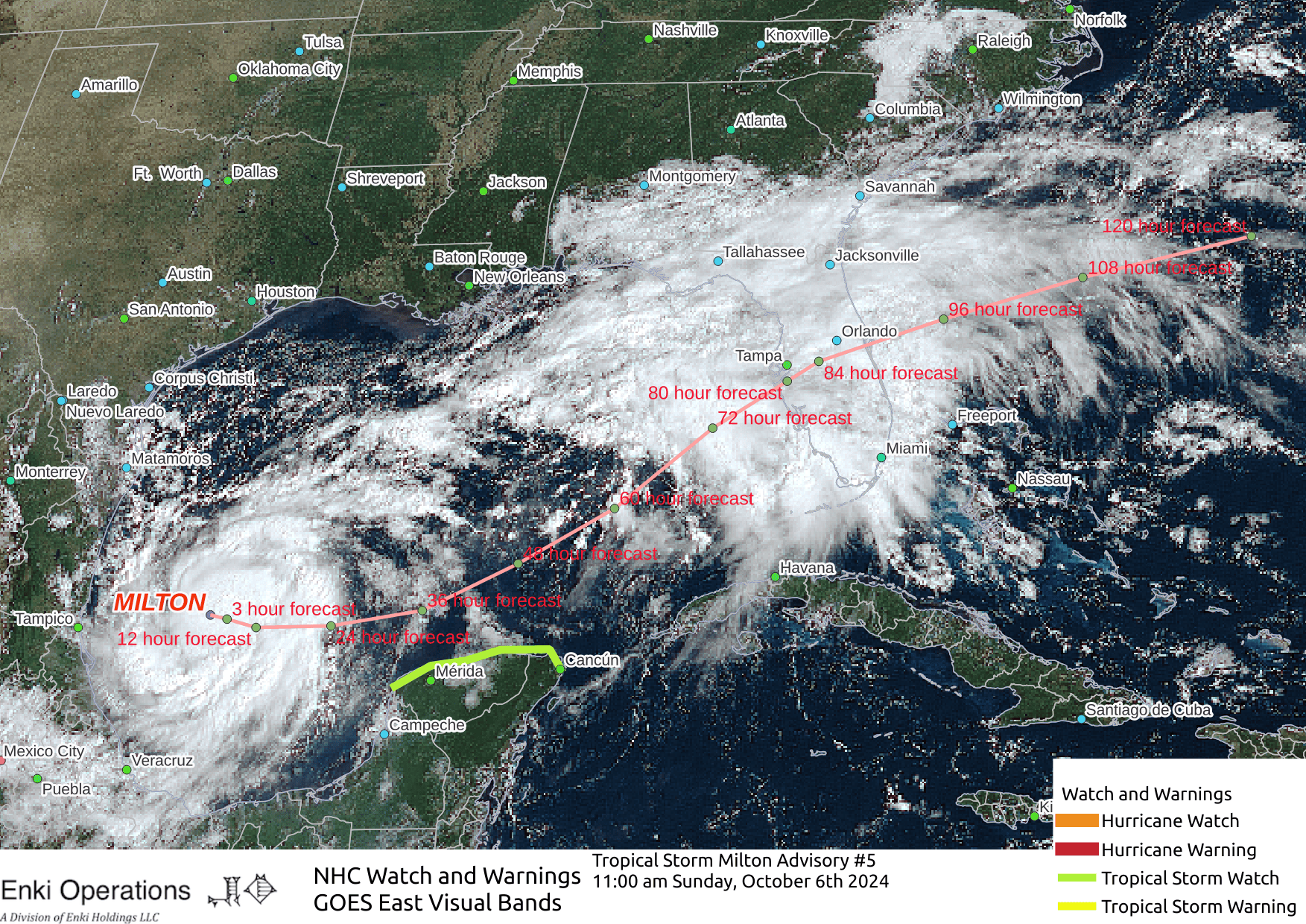
You can see the area of high shear (colored, just to the north of the storm). It’s hard to say at this point which factors will win out, but during the morning hours the storm is gathering strength and organizing:


So, again, if you are in a watch or warning area, follow the advice of your local emergency management.
Thanks so much for all who have contributed! If you like this kind of commentary you can subscribe to the emails (and/or donate to keep it going) at this link. You can also follow us on X/Twitter (@EnkiResearch) or even Facebook if that’s your preferred social media dystopia.
Would like to know what you think the future of private insurance is going to look like for coastal residents (within 50 km) over the next 10 to 15 years. Will anyone outside of the top 5% of income earners even be able to keep their residences in Florida? I can’t even understand how the economics work for that industry any longer.